
the doom loop: why escaping technology isn’t the answer
going off grid might be a selfish decision


for as long as i can remember, i have been fascinated by the relationship between technology and culture—whether they coexist symbiotically or feed off each other parasitically. it’s an ongoing debate, but i’ll let you decide where you stand.
a few months ago, i stumbled upon an idea (which i naively thought was original to me). as it turns out, it’s not. still. i find it compelling and worth exploring because it speaks to how we engage with technology. i’ve spent countless hours online reading about this theory, and though it’s not my own, it feels like something that shapes much of the world we live in today.
this concept is called the "doom loop."
to give it context, i asked chatgpt for a definition. here’s what it said:
“a 'doom loop' refers to a cycle where negative events or behaviours reinforce each other, leading to worsening outcomes. it often describes situations in economics, social dynamics, or personal behaviour where one problem leads to another, creating a feedback loop that is hard to escape. for example, in a business, poor sales might lead to cost-cutting measures, which can reduce product quality, leading to even poorer sales. essentially, it's a self-perpetuating cycle of decline.”
true enough, but not quite where i’m headed.
the doom loop i’m referring to revolves around the idea that everything we experience today is built upon something from yesterday. the more that information is passed around, the more it declines from its original state—until it becomes unrecognizable.
let me break it down more clearly.
imagine you have a piece of content, digital or physical, and you share it with person A, who shares it with person B, who shares it with person C, and so on.
what happens to that content over time?
it inevitably becomes distorted. a new narrative emerges, much like the game of reported speech we played as kids. what started as “i don’t like her” somehow transforms into “tola said bisi is a prostitute.” you get the picture.
for example, in 2013, at the global gossip games, the game started as “play is training for the unexpected,” a sort of quote from the title of a paper by biologists marek spinka, ruth c. newberry, and marc bekoff. 357 players later, the final person reported the phrase as “glow, glow, peanut butter jelly.” how? from where to where?
this distortion isn’t limited to offline communication. it happens with digital data too. think of those memes on whatsapp— up and grateful! at first, they’re crisp and clear, but after endless screenshots, reshares, and forwards, the quality deteriorates. the message might still be there, but the original form is lost.
as someone famously tweeted, “it’s always the low-quality videos.”
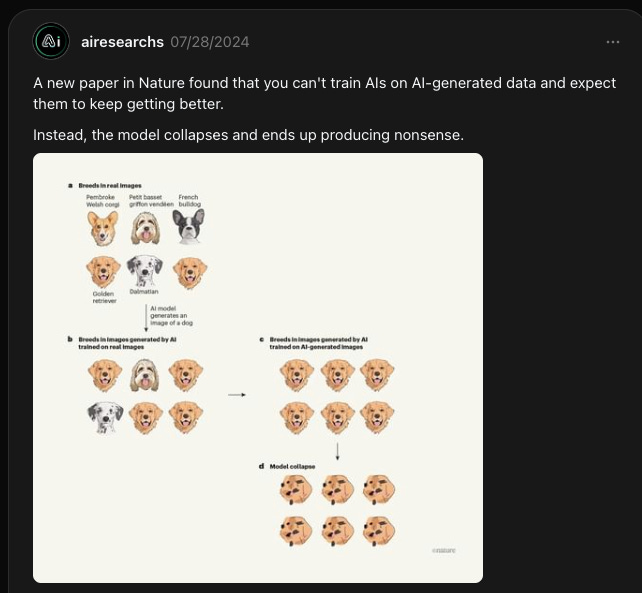
interestingly, this same phenomenon is happening with AI. the models used to train these systems are fed recycled data, and as they continue to feed off each other, the information becomes increasingly diluted.
our digital culture runs on algorithms. everything you see—whether on youtube, spotify, netflix, or instagram—is a result of an algorithm serving you content based on what you’ve previously consumed. rather than offering fresh perspectives, algorithms lean on past patterns to predict your future preferences. they play it safe by serving up familiar content, even when you’re craving something new.
and that’s the heart of the doom loop: new ideas are risky, so we’re fed recycled content. it’s ironic. tech innovation promises novelty, but the systems themselves are designed to avoid it.
this is happening across industries. take afrobeats, for example. for much of 2024, nigeria hasn’t produced a global afrobeats hit. is it due to a lack of talent or top-tier music? no. the industry has become predictable—recycling the same sounds and vibes that once excited listeners. that excitement fades when nothing feels fresh anymore. of course, rema’s recent project might be an exception, a glimpse of experimentation in an otherwise monotonous landscape.
this repetitive pattern doesn’t just exist in content or business—it shows up in people’s lives too. toxic relationships, for instance, are often built on the thrill of repeating unhealthy habits, even when they no longer serve us.
that’s what led to the downfall of companies like blackberry, yahoo, xerox and kodak.. there are countless other examples as well.
sort of like nigeria’s future if nothing changes.
this, however, is the curse of the doom loop effect. new is enjoyable for a while, then becomes old, and the pattern repeats, then repeats and repeats, until the whole cycle finally falls apart.
why going off-grid isn’t the answer

armed with this understanding, i decided to take a two-month break from social media, curious to see if i could break free from this loop. but here’s the problem: the doom loop isn’t just something you can escape by logging off the internet. it’s far more pervasive.
TL;DR: it shouldn’t be up to us as individuals to “unplug” or make responsible use of technology. businesses and corporations have a responsibility to ensure that tech betters our lives, rather than just exploiting our attention.
we’re in a crisis—one that’s defined by endless scrolling, clout chasing, trend jacking, clickbait, mental health struggles, dopamine rushes, media fatigue, and a loss of self-worth. this isn’t something we can escape by going off the grid. sorry, matrix folks.
you know you should take a break, right? put down your phone, close the laptop, and touch some grass. but here’s the thing: even if you unplug, technology will find you. spotify? youtube? e-shopping? kindle? even the "simpler" pleasures, like radio or shopping, have digital counterparts. so where does it end?
the argument might be that you can always go for the physical version of things. fine. but why are "real-world" activities like coffee dates, book readings, or gallery visits more valuable than digital ones? is it simply because they’re free of algorithms?
the uncomfortable truth is that the real battle isn’t man versus machine; it’s about coexisting with technology, especially since it’s not going anywhere.
unplugging is not the solution—it’s avoidance. and while people talk about limiting screen time or using productivity tools, these methods feel like fighting fire with fire. i used to set a three-hour limit on social media each day, but like many, i’d often blow past it. it’s not just social media either—notifications from so-called productivity or meditation apps can be enough to pull you back into the loop.
as cal newport writes, “people don’t succumb to screens because they’re lazy, but instead because billions of dollars have been invested to make this outcome inevitable.”
if billions of dollars are being invested in keeping us addicted to screens, then the decision to log off is a privilege, not courage. and that’s the core issue—opting out feels like running from the problem rather than facing it head-on.
so what can we do?
challenge authority by questioning societal norms. many of the “rules” we follow are just ideas we’ve created, not set in stone.
empower ourselves by remembering that digital spaces offer countless opportunities for participation, creation, and influence, rather than merely limiting us.
reconnect with others by fostering communities and relationships, rather than seeing them as rivals. we’re all on the same team.
nurture wonder by appreciating the present moment, using art and education to help us see the world anew.
our true strength won’t come from how well we can escape technology but from how well we can live with it peacefully. technology’s downsides should be viewed as opportunities for improvement. if we can accept that, we can start finding real solutions. ignoring technology doesn’t solve anything—it just avoids responsibility.
even though, regardless, upon still - sha go outside and touch grass!